The edited volume Climate Justice: Resisting Marginalisation (Cambridge University Press, Open Access) was recently published, examining the impacts of climate change on marginalized communities worldwide and the various forms of resistance to these impacts. A digital book launch is scheduled for 9 April 2026.
The book was co-edited by Eklavya Vasudev (FAU CHREN/IDP BHR alumnus), Marie-Sophie Keller (FAU CHREN/IDP BHR doctoral candidate), and Dr. Siddharth Peter de Souza (University of Warwick).
Climate Justice: Resisting Marginalisation examines the impact of climate change on marginalized communities across the globe and the different ways of resisting these impacts. The book underlines the imbalanced consequences of climate change, driven by the power disparities between the global North and South. It investigates how climate change aggravates structural inequalities, focusing on the intersectionality of gender, race, technology, and politics. Through a study of resistance and marginalization, the book analyses how these systemic injustices are perpetuated, while offering understandings into the struggles and strategies to build a justice oriented approach to combating climate change. This title is also available as open access on Cambridge Core.
(https://www.cambridge.org/core/books/climate-justice/7CC9EDE1CEDEA029AD99D22D2E1A5A2D#fndtn-information)
Further information

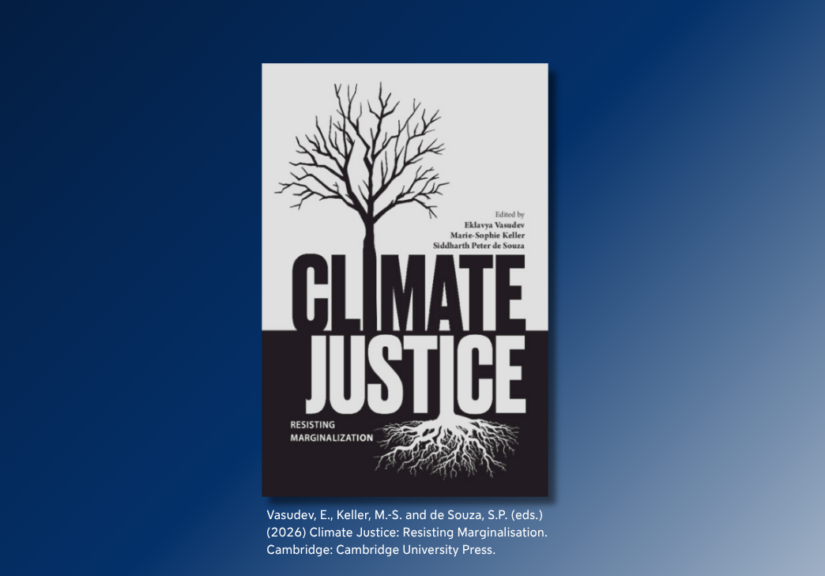
The edited volume Climate Justice: Resisting Marginalisation (Cambridge University Press, Open Access) was recently published, examining the impacts of climate change on marginalized communities worldwide and the various forms of resistance to these impacts. A digital book launch is scheduled for 9 April 2026.
The book was co-edited by Eklavya Vasudev (FAU CHREN/IDP BHR alumnus), Marie-Sophie Keller (FAU CHREN/IDP BHR doctoral candidate), and Dr. Siddharth Peter de Souza (University of Warwick).
Climate Justice: Resisting Marginalisation examines the impact of climate change on marginalized communities across the globe and the different ways of resisting these impacts. The book underlines the imbalanced consequences of climate change, driven by the power disparities between the global North and South. It investigates how climate change aggravates structural inequalities, focusing on the intersectionality of gender, race, technology, and politics. Through a study of resistance and marginalization, the book analyses how these systemic injustices are perpetuated, while offering understandings into the struggles and strategies to build a justice oriented approach to combating climate change. This title is also available as open access on Cambridge Core.
(https://www.cambridge.org/core/books/climate-justice/7CC9EDE1CEDEA029AD99D22D2E1A5A2D#fndtn-information)
Further information