Human Rights Colloquium: ‘Digital Totalitarianism and its Impact on China’s Human Rights and Civil Society’ with Visiting Fellow Dr Teng Biao and Dr Daniel Sprick
Human Rights Colloquium on Digital Totalitarianism and its Impact on China’s Human Rights and Civil Society’ with Visiting Fellow Dr Teng Biao and Dr Daniel Sprick
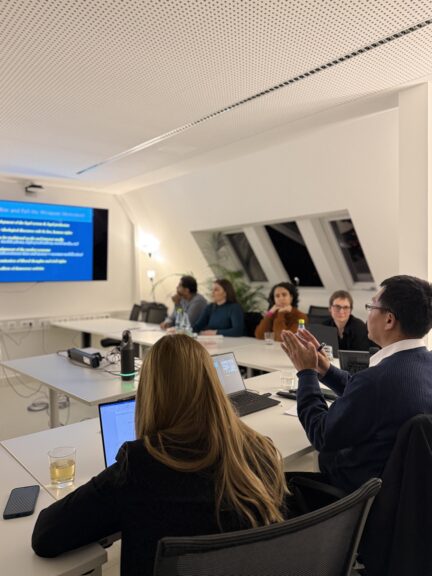
On 19 November October 2025, CHREN hosted Dr Teng Biao’s second talk, chaired by Dr Alexandra Kaiser, at which Dr Daniel Sprick acted as discussant, at a lively colloquium event. The rapid development of digital technologies has enabled unprecedented forms of state control deploying digital surveillance, big data, and increasingly also artificial intelligence to strengthen its high-tech control in ways profoundly impacting Chinese society, especially its (remaining) civil society and human rights defenders, and curtailing opportunities for advocacy and resistance.
Situating these practices within China’s overall governance system, Dr Teng characterised them as manifestations of a digital totalitarianism — a system so effective in its controlling ambitions, he contended, that it made people not only feel that it was too difficult to resist but, instead, making large numbers feel that resistance was entirely pointless. Dr Sprick challenged this analysis by raising probing questions about the reach of digital control systems, as well as the continued roles played by law-based and societal curbs on Chinese party-state power. He not only contrasted China today with the twentieth century systems (including Mao-era China) that prompted analysis of ‘totalitarian’ systems, but also analysed how algorithmic governance methods of the Chinese party-state compared to those of democratic governance systems. Their contributions invited further reflection and debate on the reach of global autocracies especially in the digital sphere. The event was made possible by Alexander von Humboldt Foundation funding support.
About the speaker, chair and discussant
Dr. Teng Biao, Image: FAU/Nathalie Schneider
Dr. Teng Biao is a human rights lawyer and a Visiting Fellow at the Chair for Human Rights Law, Friedrich-Alexander-Universität Erlangen-Nürnberg (FAU). He holds a PhD in law from Peking University and has previously served as Lecturer at the China University of Politics and Law in Beijing, Pozen Visiting Professor at the University of Chicago, Hauser Human Rights Scholar at Hunter College (City University of New York), and as a visiting fellow at the New York University, Harvard, Yale, and Princeton’s Institute for Advanced Study. Dr Teng co-founded two human rights NGOs in Beijing – the Open Constitution Initiative in 2003 and China Against the Death Penalty in 2010. His current research covers China’s human rights, social movements, law and politics, and transnational repression. His Visiting Fellowship at FAU is made possible by support of the Alexander von Humboldt Foundation.
Discussant Dr. Daniel Sprick, Image: FAU/Nathalie Schneider
Dr Daniel Sprick is a Research Associate at the Chair of Chinese Legal Culture at the University of Cologne, where he teaches a variety of courses on Chinese legal history and Chinese economic and commercial law. He was awarded the Hanenburg-Yntema Prize for the best European thesis on Chinese law in 2008. He received his PhD from the East Asian Institute at UoC on the limits of self-defense in Chinese criminal law. His research has focused on Chinese criminal law, competition law, law and society as well as law and technology in China. His comments on digital authoritarianism have appeared in The Diplomat, inter alia.
Dr. Alexandra Kaiser. Image: FAU/Nathalie Schneider.
Dr Alexandra Kaiser is Akademische Rätin / Assistant Professor at the Chair in Human Rights Law (AvH Professorship). Before joining Prof. Pils’ Chair at FAU in March 2024, Alexandra worked as a postdoctoral researcher at the Institutum Iurisprudentiae, Academia Sinica in Taipei. Previously, Alexandra worked as a research associate at the Chair of Chinese Legal Culture at the University of Cologne (2017-2020) and as a postdoctoral researcher at the Chair of Human Rights Politics (Prof. Dr. Katrin Kinzelbach), where she coordinated a project on “Academic Freedom in the People’s Republic of China” funded by the German Federal Ministry of Education and Research (BMBF) (2021-2024).
About the FAU CHREN Human Rights Colloquium
Organized by the FAU Research Center for Human Rights Erlangen-Nürnberg (FAU CHREN), our inter- and transdisciplinary brings together scholars and practitioners to discuss current issues in human rights research and practice.
Colloquia are organised on a rolling basis and are co-convened by Dr. Janina Heaphy and Prof. Dr. Eva Pils. Events are invitation-only. Enquiries should be directed to the co-conveners and/or to humanrights@fau.de.
An overview of the 2025 FAU CHREN Human Rights Colloquia is available here.

Human Rights Colloquium on Digital Totalitarianism and its Impact on China’s Human Rights and Civil Society’ with Visiting Fellow Dr Teng Biao and Dr Daniel Sprick
On 19 November October 2025, CHREN hosted Dr Teng Biao’s second talk, chaired by Dr Alexandra Kaiser, at which Dr Daniel Sprick acted as discussant, at a lively colloquium event. The rapid development of digital technologies has enabled unprecedented forms of state control deploying digital surveillance, big data, and increasingly also artificial intelligence to strengthen its high-tech control in ways profoundly impacting Chinese society, especially its (remaining) civil society and human rights defenders, and curtailing opportunities for advocacy and resistance.
Situating these practices within China’s overall governance system, Dr Teng characterised them as manifestations of a digital totalitarianism — a system so effective in its controlling ambitions, he contended, that it made people not only feel that it was too difficult to resist but, instead, making large numbers feel that resistance was entirely pointless. Dr Sprick challenged this analysis by raising probing questions about the reach of digital control systems, as well as the continued roles played by law-based and societal curbs on Chinese party-state power. He not only contrasted China today with the twentieth century systems (including Mao-era China) that prompted analysis of ‘totalitarian’ systems, but also analysed how algorithmic governance methods of the Chinese party-state compared to those of democratic governance systems. Their contributions invited further reflection and debate on the reach of global autocracies especially in the digital sphere. The event was made possible by Alexander von Humboldt Foundation funding support.
About the speaker, chair and discussant
Dr. Teng Biao is a human rights lawyer and a Visiting Fellow at the Chair for Human Rights Law, Friedrich-Alexander-Universität Erlangen-Nürnberg (FAU). He holds a PhD in law from Peking University and has previously served as Lecturer at the China University of Politics and Law in Beijing, Pozen Visiting Professor at the University of Chicago, Hauser Human Rights Scholar at Hunter College (City University of New York), and as a visiting fellow at the New York University, Harvard, Yale, and Princeton’s Institute for Advanced Study. Dr Teng co-founded two human rights NGOs in Beijing – the Open Constitution Initiative in 2003 and China Against the Death Penalty in 2010. His current research covers China’s human rights, social movements, law and politics, and transnational repression. His Visiting Fellowship at FAU is made possible by support of the Alexander von Humboldt Foundation.
Dr Daniel Sprick is a Research Associate at the Chair of Chinese Legal Culture at the University of Cologne, where he teaches a variety of courses on Chinese legal history and Chinese economic and commercial law. He was awarded the Hanenburg-Yntema Prize for the best European thesis on Chinese law in 2008. He received his PhD from the East Asian Institute at UoC on the limits of self-defense in Chinese criminal law. His research has focused on Chinese criminal law, competition law, law and society as well as law and technology in China. His comments on digital authoritarianism have appeared in The Diplomat, inter alia.
Dr Alexandra Kaiser is Akademische Rätin / Assistant Professor at the Chair in Human Rights Law (AvH Professorship). Before joining Prof. Pils’ Chair at FAU in March 2024, Alexandra worked as a postdoctoral researcher at the Institutum Iurisprudentiae, Academia Sinica in Taipei. Previously, Alexandra worked as a research associate at the Chair of Chinese Legal Culture at the University of Cologne (2017-2020) and as a postdoctoral researcher at the Chair of Human Rights Politics (Prof. Dr. Katrin Kinzelbach), where she coordinated a project on “Academic Freedom in the People’s Republic of China” funded by the German Federal Ministry of Education and Research (BMBF) (2021-2024).
About the FAU CHREN Human Rights Colloquium
Organized by the FAU Research Center for Human Rights Erlangen-Nürnberg (FAU CHREN), our inter- and transdisciplinary brings together scholars and practitioners to discuss current issues in human rights research and practice.
Colloquia are organised on a rolling basis and are co-convened by Dr. Janina Heaphy and Prof. Dr. Eva Pils. Events are invitation-only. Enquiries should be directed to the co-conveners and/or to humanrights@fau.de.
An overview of the 2025 FAU CHREN Human Rights Colloquia is available here.