
Public Lecture by Irene Khan about Threats to Freedom of Expression in Germany and Beyond
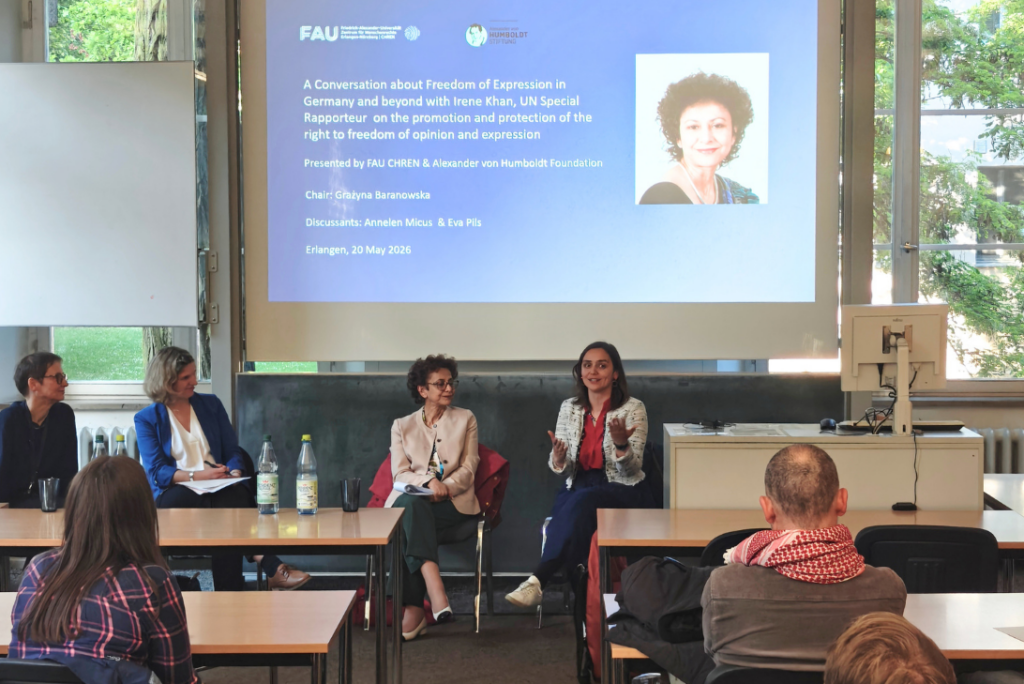
On 20 May 2026, the FAU Research Center for Human Rights Erlangen-Nürnberg (FAU CHREN), with the support of the Alexander von Humboldt Foundation, hosted a public lecture with Irene Khan, United Nations Special Rapporteur on the promotion and protection of the right to freedom of opinion and expression. Chaired by Professor Grażyna Baranowska and featuring comments from Professor Eva Pils and Dr. Annelen Micus from the European Center for Constitutional and Human Rights (ECCHR), the event explored current challenges to freedom of expression and academic freedom in Germany and beyond. Drawing on observations from her visit to Germany in from 26 January to 6 February 2026 and her much-anticipated report on freedom of expression in the country, Ms. Khan discussed the impact of political polarization, hate speech, disinformation, and shrinking civic space on democratic debate and fundamental rights and outlined why she thought that some of Germany’s legal restrictions on freedom of expression went too far. The event concluded with an interactive Q&A session moderated by Professor Baranowska.
Prior to the public lecture, Ms. Khan also participated in an academic roundtable with FAU-based human rights researchers chaired by Dr. Janina Heaphy. The discussion at FAU CHREN focused on contemporary challenges to freedom of expression, such as the growing influence of digital platform owners on public discourse, states’ cooperation with UN human rights mechanisms, and the implications of increasing financial pressures on the United Nations system. Participants also had the opportunity to discuss their own research and engage directly with Ms. Khan on questions related to freedom of expression in different national and academic contexts.

Freedom of Expression Under Pressure: Germany in Comparative Perspective
The public lecture brought together students, researchers, and members of the wider public to discuss current challenges to freedom of expression in Germany and internationally. In her introduction, Professor Baranowska situated the discussion within broader debates on democratic resilience, constitutional freedoms, and the protection of human rights institutions.
In her lecture, Irene Khan described Germany as a particularly significant case in the global debate on freedom of expression: a country with a strong constitutional framework, robust institutions, and a clear historical commitment to human rights, which nevertheless faces what she characterized as “grave challenges” to its democratic discourse. She recognised that freedom of expression and academic freedom are firmly protected under the German Basic Law (Grundgesetz) and that these freedoms constitute a central pillar of the country’s post-war democratic order. At the same time, she warned that increasing political polarization, heightened social tensions, and growing hostility in public debate are contributing to a contraction of civic space, necessitating responses to defend these freedoms.
Ms. Khan further expressed her understanding for the notion that Germany’s historical experience entails a particular international responsibility, as developments in the country are closely observed worldwide. In her assessment, any weakening of democratic safeguards or narrowing of open discourse in Germany would have implications that extend beyond its borders.
Hate Speech, Polarization and the Boundaries of Free Expression
A central theme of Irene Khan’s intervention was the perceived tension between the need for robust protection of freedom of expression and the need to address hate speech, disinformation, and extremist rhetoric. She explained that democratic societies face a dual challenge: responding to harmful speech without undermining the very freedoms that enable democratic participation. She also set out the reasons for a principled optimism that both goals can be achieved.
Ms. Khan highlighted a marked increase in antisemitic, Islamophobic, anti-migrant, and gender-based hate speech in Germany, which she linked to broader processes of political and social polarization. She noted that similar dynamics were also visible in the increasing normalization of exclusionary rhetoric in mainstream political discourse, contributing to a broader erosion of shared democratic norms.
Particular concerns arise regarding speech in the context of the Israel–Palestine conflict. Participants discussed the risks of both hate speech and overbroad restrictions on expression, including in academic and civil society contexts. Ms. Khan emphasized the difficulty of maintaining a balance between protecting individuals from discrimination and preserving open political debate on contested international issues.
Defensive Democracy, Speech Crimes, and Protest
Building on Ms. Khan’s observations, Professor Pils reflected on the concept of a “defensive” or “militant democracy” (wehrhafte Demokratie) and Germany’s increasing reliance on criminal law frameworks in responding to political polarization. Referring to criminal cases involving charges of ‘downplaying an act committed under National Socialism’ and of ‘insult directed at persons in political life’ under the German Criminal Code, she raised questions about the compatibility of these legal provisions and their application with international human rights law standards on freedom of expression, such as Article 19 ICCPR. In response, Ms. Khan referenced her forthcoming report and its proposals for legal reforms.
The discussion further addressed climate activism in Germany, including legal proceedings involving groups such as the Letzte Generation. Participants reflected on how legal classifications and security-related framings of protest activity may affect the boundaries of legitimate civic engagement and contribute to a narrowing of public space for political contestation. These dynamics were also situated within a broader European and transatlantic context.
Academic Freedom and Chilling Effects
Dr. Annelen Micus focused on the intersection of freedom of expression and academic freedom. Drawing on ECCHR’s research with academic partners (“Grey Zones, Red Lines” project), she highlighted how political rhetoric, event cancellations, disciplinary measures, and broader processes of securitization may create uncertainty among migrant researchers and students regarding the boundaries of permissible expression.
She emphasized that such developments could produce a chilling effect within universities and may have particularly significant consequences for international academics and students whose residence status or career trajectories may be affected by institutional or legal responses to controversial speech. Dr. Micus stressed the importance of safeguarding universities as spaces for critical inquiry, open debate, and intellectual exchange.
Conceptual Uncertainty and Civic Space
Irene Khan further argued that restrictions on freedom of expression are not only the result of formal censorship or surveillance, but may also emerge through indirect mechanisms such as intimidation, social pressure, and institutional uncertainty. Universities and civil society institutions, she noted, remain essential arenas for sustaining democratic engagement and pluralistic debate.
She also drew attention to the role of contested and vague concepts such as “extremism” and “antisemitism,” arguing that their lack of precise and universally shared definitions can create legal ambiguity and contribute to inconsistent application of the law in practice. In her view, such conceptual uncertainty risks weakening, rather than strengthening protections against discrimination and hate.
Legal Frameworks and Democratic Accountability
Ms. Khan emphasized that international human rights law provides established frameworks for assessing the limits of permissible expression, including contextual approaches to harm and incitement. She cautioned against overreliance on broad or politically contested definitions that may shift depending on institutional or political context.
In this regard, she also referred to the role of soft-law instruments and parliamentary resolutions that, while not legally binding, may nonetheless shape administrative and legal practice. She argued that such developments require careful scrutiny, particularly when they influence restrictions on expression without equivalent judicial review.
Concluding Reflections
In her concluding remarks, Ms. Khan called for greater clarity, consistency, and adherence to universal human rights standards in addressing hate speech and protecting freedom of expression. She stressed that democratic societies must ensure equality of protection across different forms of hate, including antisemitism, anti-Muslim hatred, anti-migrant rhetoric, and other forms of discrimination, and that freedom of speech must not be unduly restricted.
A more coherent and universally grounded approach to human rights law could strengthen both legal certainty and public trust. She further proposed that Germany could benefit from a systematic review of recent developments affecting protest rights and civic space, including through an independent commission of inquiry, as part of a broader effort to restore trust and transparency.
About the Speaker Irene Khan
As the first woman to serve as UN Special Rapporteur on freedom of opinion and expression, Irene Khan brought extensive experience in international human rights advocacy to the discussion. Prior to her appointment in 2020, she served as Secretary General of Amnesty International and later as Director-General of the International Development Law Organization (IDLO).
Ms. Khan is expected to present her report to the Human Rights Council on 18 June. As scheduling within the Council can occasionally change, the presentation date may still be subject to minor adjustments.
Learn more about Irene Khan’s UN mandate here: https://www.ohchr.org/en/special-procedures/sr-freedom-of-opinion-and-expression
Recording
Ms. Khan’s lecture was recorded and is available on our YouTube channel.
Please note: By clicking on the link, you will leave our website and access content from YouTube (Google Ireland Limited). YouTube may store cookies and analyse your usage behaviour. For more information, please refer to Google’s privacy policy. Alternatively, the video can also be accessed directly at fau.tv.
(Recording by FAU MMZ, 20.05.2026).
This event was made possible by the kind support of Alexander von Humboldt Foundation.
10.06.2026 FAU CHREN/fm, nw, gb, emp.
Images: FAU CHREN/Florian Murphy.