
On 14 July 2026, the FAU Center for Human Rights Erlangen-Nürnberg (CHREN) welcomed Professor Alyssa King, Associate Professor at Queen’s University Faculty of Law (Canada) and Visiting Fellow at the FAU Chair for Human Rights Law, for a Colloquium drawing on the example of Hong Kong to examine the relationship between special economic zones and human rights.
Event recap
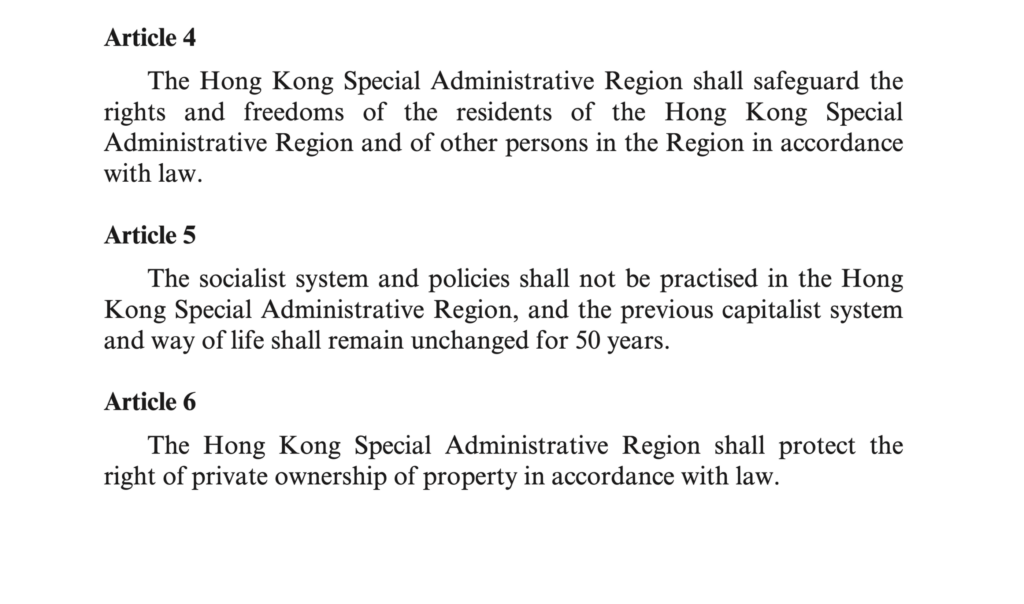
Professor King explored how the creation of ‘special’ or ‘offshore’ jurisdictions has become an important legal strategy for managing international economic integration. Hong Kong’s status as a Special Administrative Region, with its separate common law legal system guaranteed under the Sino-British Joint Declaration and the PRC Constitution, has served as a model for other special jurisdictions, including the Dubai International Financial Centre, the Astana International Financial Centre, and Próspera in Honduras. These jurisdictions are designed to provide foreign investors with familiar legal institutions, reliable court procedures, support for international arbitration, and strong protection of property rights, while remaining institutionally distinct from the domestic legal system.
Alyssa King’s framing allowed her to discuss Hong Kong not simply as a story of the decline of the rule of law under Chinese party-state control, but as an example of a broader tension inherent in legal special zones. Hong Kong’s internationally celebrated common law system, openness to global commerce, and separate jurisdiction constituted a ‘high’ rule-of-law model that facilitated transnational capitalism; yet this legal exceptionalism always had a corresponding ‘low’ counterpart: spaces of legal exception designed to accommodate rule-of-law constraints. Hong Kong’s trajectory thus shows that legal separation has long served both commercial integration and political control. It also demonstrates the limitations of the ‘special zone:’ such zones are, after all, inhabited by citizens with claims to human rights, democracy, and the rule of law, as illustrated by Hong Kong’s civil society protests and the introduction of national security legislation and revival of sedition law in response.
The discussion raised broader questions about whether the coexistence of ‘high’ and ‘low’ dualism is structurally necessary and whether rule-of-law ideals could survive, or stay meaningful, in such settings.
The event was supported by funding from the Alexander von Humboldt Foundation provided to the Chair for Human Rights Law.
About the speaker
Professor Alyssa King is Associate Professor (with tenure) at Queen’s University Faculty of Law in Kingston, Ontario, Canada, and is currently a Visiting Fellow associated with the FAU Chair for Human Rights Law. She researches comparative civil procedure, courts, and arbitration, and teaches contracts, cross-border litigation, and civil procedure. Her work focuses on the diffusion of procedural rules across legal systems, as well as questions of federalism, access to justice, and the interaction between domestic and international legal orders.
About the FAU CHREN Human Rights Colloquium
Organized by the FAU Research Center for Human Rights Erlangen-Nürnberg (FAU CHREN), our inter- and transdisciplinary brings together scholars and practitioners to discuss current issues in human rights research and practice.
Colloquia are organised on a rolling basis and are co-convened by Dr. Janina Heaphy and Prof. Dr. Eva Pils. Events are invitation-only. Enquiries should be directed to the co-conveners and/or to humanrights@fau.de.