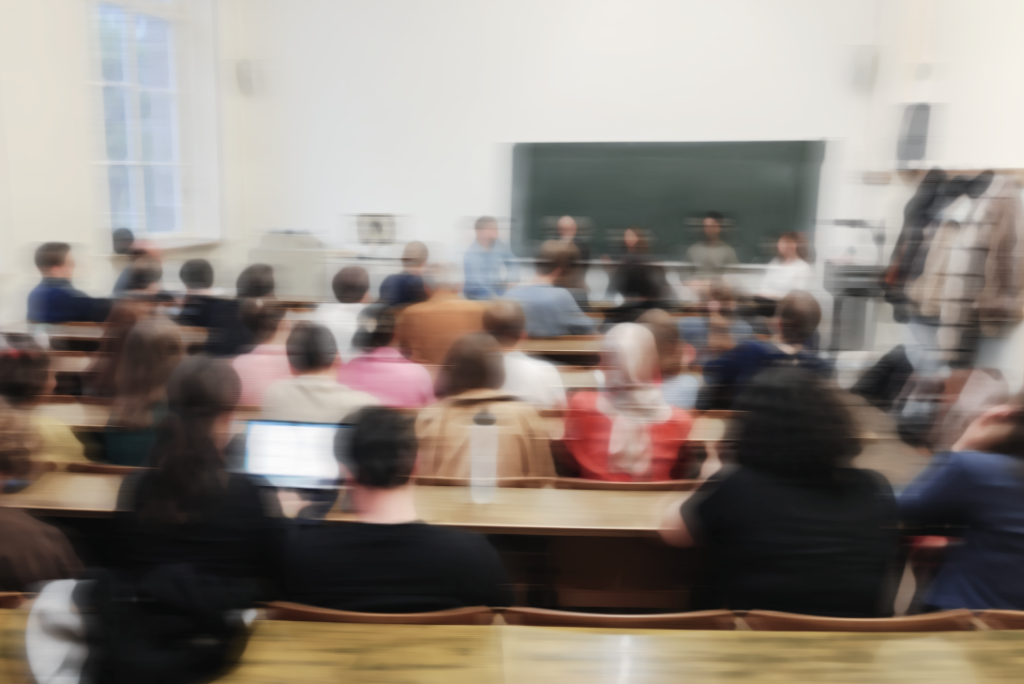
How can the international community respond to an escalating human rights, humanitarian, political, and security polycrisis in Iran? A recent panel discussion at FAU CHREN, sponsored by an Alexander von Humboldt Foundation award to the Chair for Human Rights Law, brought together a group of experts to examine the country’s rapidly evolving situation. The conversation was significantly shaped by the outbreak of war on 28 February 2026, which has further destabilised an already fragile political, legal and social order.
The war was framed throughout the discussion as a critical rupture with wide-ranging consequences that extend beyond immediate military developments. Reactions within Iranian society were described as deeply heterogeneous, ranging from fear and existential insecurity to cautious hope that the current power structures may eventually be transformed. At the same time, the war was understood as a profoundly complex social phenomenon, with responses shaped by regional, social, and political differences across the country.
Beyond its immediate humanitarian toll, participants emphasised the broader geopolitical implications of the conflict. It was argued that the trajectory of the war may lead to significant shifts in regional alignments and global influence structures, including the possibility that the United States could lose influence in parts of the Arab world or in Pakistan, while China may expand its political and economic presence across the wider Middle East and North Africa region. These potential shifts were linked to concerns about long-term instability, post-conflict reconstruction, and the reconfiguration of international order. At the same time, some contributions highlighted the resilience, agency, and collective energy of Iranian society as a source of cautious hope even under extreme conditions.
Humanitarian Impact, Repression, and Fragmentation
The discussion addressed a range of interconnected humanitarian and political developments that have intensified in both the pre-war and current war context. Particular attention was given to worsening humanitarian conditions, systematic restrictions on civil liberties, and entrenched patterns of state repression of dissent and wider, systematic human rights violations including discrimination against women and marginalised ethnoreligious groups.
Developments of concern included the expansion of mass arbitrary detention, politically motivated executions, denial of access to legal counsel, severe limitations on freedom of expression, and extensive internet shutdowns. Movement restrictions through checkpoints and heightened surveillance were also identified as central mechanisms shaping everyday life under conditions of intensified militarisation.
Across the panel contributions, it was emphasised that human rights violations are not peripheral to the crisis, but constitutive of how it is governed. At the same time, speakers warned that the visibility of these violations risks being reduced by the geopolitical framing of the war, despite their continued escalation.
The war was also discussed as a process of social fragmentation. Rather than being limited to physical destruction, it was described as contributing to the dismantling of social cohesion and the erosion of a shared sense of collective belonging. Narratives framing segments of society as internal “enemies” were identified as particularly consequential, as they may deepen divisions and complicate any future efforts towards reconciliation or reconstruction.
Competing Interpretations of the Current Crises
The panel brought together different perspectives on the roots of the current crisis. While some contributions emphasised external geopolitical pressures, others focused on internal structural dynamics, including economic strain, governance deficits, and long-standing patterns of political exclusion.
One panellist situated the crisis within a longer historical trajectory of uneven and combined development. They argued that Iran’s state-led nation-building project under conditions of external pressure produced a centralised conception of the nation that relied on coercive incorporation of internal diversity. In this reading, the post-1979 state combined contradictory ideological and republican elements while failing to deliver on promises of equity, liberty, and prosperity. Over time, this configuration has evolved into a militarised state structure that instrumentalises external crises for internal political reproduction. The convergence of these dynamics with shifting global power relations, including US relative decline and regional expansionist dynamics, was presented as central to understanding the current war.
Other panellists suggested different narratives, including a stronger focus on gendered dimensions of the current legal-political crises, Despite differing analytical approaches, however, there was broad agreement that the situation cannot be reduced to a single causal narrative, but must instead be understood as the intersection of multiple long-term and immediate crisis dynamics.
Civil Society, Protest Trajectories, and Forms of Resistance
A key strand of the discussion focused on the evolution of protest movements and social mobilisation in Iran over recent decades. Another panellist traced a continuum of collective action spanning student movements, the 1999 protests, the Green Movement, the 2017 and 2019 uprisings, and the “Woman, Life, Freedom” movement and its aftermath. They argued that these episodes should not be understood as isolated eruptions, but as part of a longer trajectory of contentious politics shaped by shifting political opportunity structures. Despite escalating repression, they emphasised that non-violence has remained a consistent normative and strategic feature of Iranian collective action.
In the current war context, however, the conditions for mobilisation have become significantly more constrained. Severe internet censorship and repeated communication blackouts, alongside extensive surveillance infrastructures, mass arrests, and executions, were highlighted as central mechanisms shaping civil society’s operating environment. Restrictions on movement through checkpoints further intensify fragmentation and limit the ability of individuals and groups to organise collectively.
International Actors, Responsibility, and Policy Constraints
A substantial part of the discussion focused on the role of international actors, particularly Germany and the European Union. Contributions critically examined existing foreign policy approaches, highlighting tensions between normative human rights commitments and state-centric strategic priorities.
One panellist argued that ‘Western’ Iran policy has not merely failed but has, in practice, contributed to stabilising the Islamic Republic by reinforcing a dual logic of engagement and containment. This dynamic, they suggested, has simultaneously legitimised the Iranian state while strengthening its internal repressive capacities through external threat narratives. In this framing, Iranian civil society has often been marginalised as a political actor, narrowing the scope of international policy imagination and reinforcing a state-first approach to diplomacy.
The discussion also addressed what more effective support for civil society could entail. This included political pressure, targeted support for human rights defenders, and legal and humanitarian assistance, while also recognising the structural limitations of external influence under conditions of war, repression, and digital isolation.
Human Rights, Knowledge Production, and Visibility
One of the panellists highlighted the risk that the war may shift attention away from ongoing patterns of internal repression in Iran. They argued that people in the country are currently experiencing two overlapping forms of violence: the direct consequences of war, including bombardment, destruction of infrastructure, displacement, and environmental damage, alongside an intensified state crackdown marked by mass arrests, surveillance, internet shutdowns, restrictions on communication, and executions following rapid and opaque judicial proceedings.
While many of these developments have intensified since the outbreak of the war, they stressed that they form part of a longer history of state violence. They argued that the current moment represents not a rupture but a significant escalation of existing patterns of repression, extending from the mass executions of political prisoners in the 1980s through successive crackdowns on dissent and protest movements to the large-scale repression of the 2025–2026 protests. Human rights violations, they emphasised, are not incidental but central to the crisis management.
A central concern of their intervention was the growing dominance of security-based narratives in international discussions about Iran. While increasing attention to human rights violations in recent years had created greater space for accountability and evidence-based debate, they observed that the war has prompted a renewed focus on geopolitical and ideological frameworks. Discourses centred on terrorism, espionage, and foreign interference, they argued, increasingly overshadow human rights concerns and risk obscuring the experiences of victims of state violence.
They also emphasised the importance of witnesses and human rights lawyers inside the country as crucial sources for documenting violations and challenging official narratives through evidence-based reporting. Drawing on their own experience as a lawyer and as part of networks supporting detainees and their families, they questioned the discrepancy between official security narratives and the backgrounds of many individuals subjected to repression.
This panellist further drew attention to an emerging dynamic in which human rights are increasingly deprioritised not only by state actors but also within competing political agendas, including segments of opposition discourse. This, they argued, risks eroding earlier progress in embedding human rights as a central normative framework within Iranian society, while simultaneously pushing these issues to the margins of international diplomacy and public debate. They concluded by stressing that discussions about Iran should remain grounded in the experiences, testimonies, and documentation produced by those directly affected by these developments.
Outlook: Accountability, Hope, and Uncertain Futures
Looking ahead, the discussion addressed questions of accountability, conflict resolution, and long-term political transformation. While no singular pathway emerged, there was broad agreement that sustained engagement with both immediate humanitarian needs and deeper structural conditions remains essential.
Several contributions emphasised that war tends to weaken civil society by increasing fragmentation and restricting organisational capacity, reinforcing the urgency of de-escalation and protection of civilian populations.
Despite the severity of the current situation, the discussion also contained moments of cautious optimism grounded in the resilience and continued agency of Iranian society. However, this was consistently framed within a broader recognition of uncertainty, structural violence, and ongoing risk.
The event was conducted under the Chatham House Rule to enable an open exchange of views.