
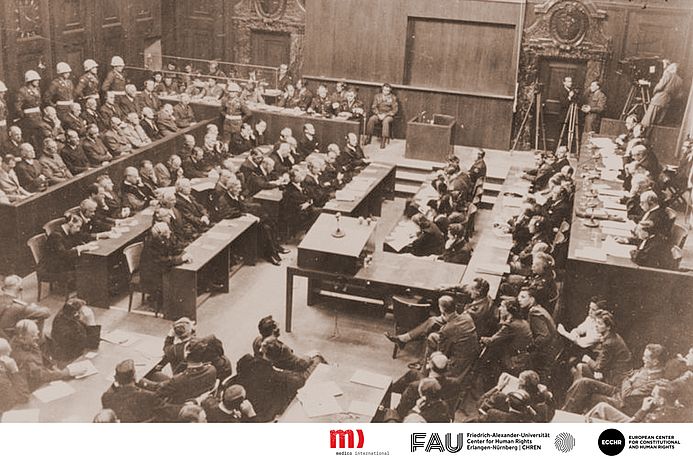
80 Years after the Nuremberg Trials – Current Struggles for Justice & Solidarity
Eighty years ago in Nuremberg, a regime responsible for wars of aggression and mass crimes stood trial before an international court for the first time—a historic turning point that shaped modern international law and established the principle that even state power must not stand above the law.
But whose rights matter today? Wars, border regimes, geopolitical interests, and authoritarian rule all play a role in determining whose suffering is acknowledged—and whose is not. Anyone who takes Nuremberg seriously must focus precisely on these power dynamics.
At the same time, survivors, civil society organizations, and countries of the Global South are fighting to make the law a tool for justice: This year, the International Criminal Court opened two cases for which survivor organizations from the Philippines and refugees from Libya had long fought. In Belgium, the murder of Congo’s first Prime Minister, Patrice Lumumba, is being investigated, and executives of the construction materials company Lafarge were convicted in France of financing terrorism during the Syrian civil war.
What is the current state of international law, what challenges does it face—and what new paths to justice are emerging? We will explore these questions together.
The detailed program and information about our guests can be found below.
The event will be held in English.
Simultaneous translation into German will be provided.
Registration & Admission
Panels
Participation in the panels is free of charge.
Please register via this link.
Location: FAU CHREN | Andreij-Sacharow-Platz 1 | 90403 Nuremberg
Accessibility Information: The venue is accessible by elevator. If you require sign language interpretation or other assistive services, please contact us.
Film: *My Illegal Life*
Admission: €12.50
Tickets: at CINECITTA’
Cinema: CINECITTA’ | Gewerbemuseumsplatz 3 | 90403 Nuremberg
Organized by: medico international, ECCHR, and the FAU Research Center for Human Rights Erlangen-Nürnberg (FAU CHREN).
Program
2:00 – 2:30 p.m. Welcome and Opening Remarks
Prof. Dr. Markus Krajewski, FAU CHREN
2:30 – 3:30 p.m. A Chance for Justice or the Decline of the International Legal Order?
International law has never been neutral—its framework still bears traces of colonialism and imperialism to this day, and realpolitik continually challenges it. Despite this ambivalence, survivors of the most severe human rights crimes worldwide invoke this law, particularly in the Global South, where its emancipatory potential is recognized just as much as its weaknesses.
An example: Through the ECCHR, the migrant organization Refugees in Libya is representing survivors of torture camps in Libya in proceedings before the International Criminal Court. For those affected, this means recognition of their suffering and holds those responsible
For those affected, this means recognition of their suffering and highlights the responsibility of European actors.
David Yambio, Refugees for Libya
Dr. Miriam Saage-Maaß, ECCHR
Moderator: TBD
3:30 – 4:00 p.m. BREAK
4:00 – 5:00 p.m. The Political Mandate of Nuremberg
“War of aggression is the greatest crime”—with these words, Nuremberg’s chief prosecutor Benjamin Ferencz went down in history, for it is war of aggression that makes other crimes such as murder, robbery, and destruction possible in the first place. The newly established international criminal law was intended to ensure that wars and their crimes would no longer go unpunished in the future and to protect human dignity and freedom. The 1948 Universal Declaration of Human Rights was the logical consequence. Even though it never applied to everyone in practice, international law and human rights remained the standard by which accountability is demanded.
How can this political mandate from Nuremberg be defended and carried forward today—through which self-organized groups, which transnational alliances, and what kind of solidarity beyond European self-centeredness? Which voices are being ignored? And what would it mean to view Nuremberg not as a moral legacy to be managed, but as an open mandate: to defend universal dignity against disenfranchisement and organized irresponsibility?
Prof. Dr. Nikita Dhawan, University of Dresden
Charlotte Wiedemann, journalist
Hadi Marifat, Afghanistan Human Rights and Democracy Organization (AHRDO)
Moderator: Dr. Imad Mustafa, medico international
5:00 – 7:00 p.m. Evening reception
7:30 p.m. Film “My Illegal Life” & discussion with Esther Dischereit, poet and essayist
Winter 1942: Hella Zacharias holds the Gestapo’s deportation order in her hands—and goes into hiding in Berlin with her 5-year-old daughter, Hannelore. Months of hiding, denunciations, and hasty escapes follow. In 1944, living under a false name in Sorau / Żary in present-day Poland, she is rescued by railroad worker Fritz Kittel: He hides Hella in his apartment and passes Hannelore off as his niece—all while his employer, the Deutsche Reichsbahn, sends millions to their deaths.
After the war, Hella Zacharias has another child: Esther Dischereit, who goes on to become one of the most significant German-Jewish writers after the Holocaust. She knows the name Fritz Kittel from her childhood—but she has never met him. Together with her daughter Chana, she sets out to find her family’s rescuer and the missing pieces of her own history.
Our Guests
Prof. Dr. Nikita Dhawan studied philosophy and gender studies in Mumbai and earned her Ph.D. in philosophy from Ruhr University Bochum in 2006. After holding professorships in Oldenburg, Frankfurt, and Innsbruck, she has been teaching political theory and the history of ideas at TU Dresden since 2021. She directed the Frankfurt Research Center for Postcolonial Studies and received the Käthe Leichter Prize in 2017 for her research on women’s and gender equality.
Esther Dischereit, born in Heppenheim in 1952, is a German-Jewish writer whose work explores the assimilation of Jews in Germany. Before embarking on her writing career in 1985, she worked in the metal industry and as a typesetter. With *Joëmis Tisch* and *Übungen, jüdisch zu sein*, she became one of the most important literary voices among the descendants of Shoah survivors. In 2009, she received the Erich Fried Prize, and in 2026, the Grand Prize of the German Literature Fund for her life’s work.
Prof. Dr. Markus Krajewski has held the Chair of Public Law and International Law at FAU Erlangen-Nuremberg since 2010 and is deputy spokesperson for the FAU Research Center for Human Rights Erlangen-Nuremberg (FAU CHREN). He is Secretary General of the German Association for International Law and served as Chair of the Board of Trustees of the German Institute for Human Rights from 2016 to 2024.
Hadi Marifat is the founder and director of the Afghanistan Human Rights and Democracy Organization (AHRDO). He served as a country analyst at the Center for Civilians in Conflict and Human Rights Watch, as well as a human rights officer with the UN Mission in Afghanistan (UNAMA). He studied political science and international relations at the London School of Economics (LSE) and Erasmus University Rotterdam.
Dr. Imad Mustafa is a political scientist, author, and human rights advisor at medico international, where he is responsible for Afghanistan, North Africa, and West Asia. His research focuses on anti-Muslim racism, post-migrant society, and political movements in North Africa and West Asia. His most recent publication is *Islam Does Not Belong to Germany* (2023), and he is co-editor of the book series *Racism/Society: Transdisciplinary Perspectives, published by VS Springer.
Dr. Miriam Saage-Maaß is a lawyer and Legal Director at the European Center for Constitutional and Human Rights (ECCHR), where she established the Business and Human Rights program. She has filed lawsuits against companies for labor exploitation in Bangladesh and Pakistan, as well as criminal proceedings against executives for their involvement in international crimes such as arms exports to Saudi Arabia. In 2016, she received the Hans Litten Prize; she serves on the advisory board of the Bonavero Human Rights Institute in Oxford and the Forum Recht Foundation.
Charlotte Wiedemann writes books, essays, and feature articles on international topics, having long focused on Islamic societies, and has conducted research in some 30 non-European countries, from Mali to Yemen. She publishes in Geo, Die Zeit, and Le Monde Diplomatique, among others, and is a columnist for the taz. Since 2020, she has served on the academic advisory board of the Leibniz Center for Modern Orient Studies, and since 2025, on the board of trustees of the medico Foundation.
David Yambio is a human rights activist and co-founder of Refugees in Libya, an organization run by refugees themselves that documents human rights violations in North Africa and the central Mediterranean. After being forcibly recruited in South Sudan, detained and exploited in Libya, and making several failed attempts to flee, he managed to escape to Italy in 2022. From there, he now leads his global campaign for migration justice.