
Public Keynote Lecture by Dr. Matthew Canfield: Towards Transdisciplinarity? Remaking Human Rights Research in Volatile Times
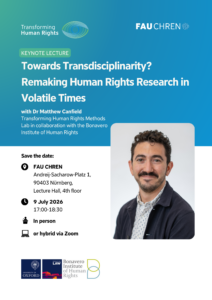
Date: 9 July 2026Time: 17:00 – 18:30Location: Lecture Hall, 4th floor, FAU CHREN, Andreij-Sacharow-Platz 1, 90403 Nürnberg or via Zoom
Keynote Address is part of the Transforming Human Rights Methods Lab in collaboration with the Bonavero Institute of Human Rights
Date and time: 9th July 2026 17.00-18.30
Location: In person at Nuremberg, FAU Forschungszentrum Center for Human Rights Erlangen-Nürnberg (FAU CHREN) 20201.03.210 (Hörsaal / Lecture Hall). Hybrid: via Zoom
As computational technologies reshape our world, the very foundations of our legal systems are beginning to crack. How do we protect human rights when the “old ways” of law and scholarship are no longer enough?
Join us for keynote lecture by Dr. Matthew Canfield challenging us to rethink not just the law, but the way we produce knowledge itself.
Dr. Matthew Canfield is a cultural anthropologist and a socio-legal scholar. His research sits at the intersection of human rights, global governance, and environmental politics, focusing on rights-based approaches to food systems. He is author of Translating Food Sovereignty: Cultivating Justice in an Age of Transnational Governance (Stanford University Press, 2022), which examines how transnational food sovereignty movements are transforming the meaning and practice of human rights in their struggle build more sustainable and equitable food systems. Currently, he is the Principal Investigator of Data Governance for Sustainable and Equitable Food Systems (DigiFood), an ERC-Consolidator funded project (2025-2030). The project examines emerging forms of agricultural data governance at the transnational level, with a specific focus on Kenya, India, and Colombia. He works at the Van Vollenhoven Institute for Law, Governance, and Society at Leiden Law School as Associate Professor of Law and Society & Law and Development.
This event is funded by the Deutsche Forschungsgemeinschaft (DFG, German Research Foundation) under Germany’s Excellence Strategy – EXC 3039 – 533607764.
To register, please send an email to Lama Ranjous at lama.ranjous@fau.de by 25th of June
Session Abstract
The convergence of computational technologies and rising authoritarianism is reshaping the liberal legal order. As human rights face unprecedented pressure, many scholars committed to social justice are wrestling with how to contribute to their renewal. One way forward is to reimagine the methods of scholarship itself. While the advance of interdisciplinary methods has encouraged greater empirical engagement and reflexivity, they nonetheless remain rooted in colonial forms of knowledge production that reify epistemic and institutional hierarchies, subject/object separations, and instrumental legal rationalities. Transdisciplinarity, an approach that seeks to transcend disciplinary boundaries, offers a promising alternative. It encourages the integration of diverse forms of knowledge to reflexively address social problems. Yet adopting transdisciplinary approaches in human rights also raises tensions. This talk explores these tensions through the lens of digital rights—an illuminating arena of emerging social struggle because it exemplifies a new generation of rights claims that can challenge the ontological and epistemological assumptions of liberal legal frameworks.
Event Details
Lecture Hall, 4th floor, FAU CHREN, Andreij-Sacharow-Platz 1, 90403 Nürnberg or via Zoom