
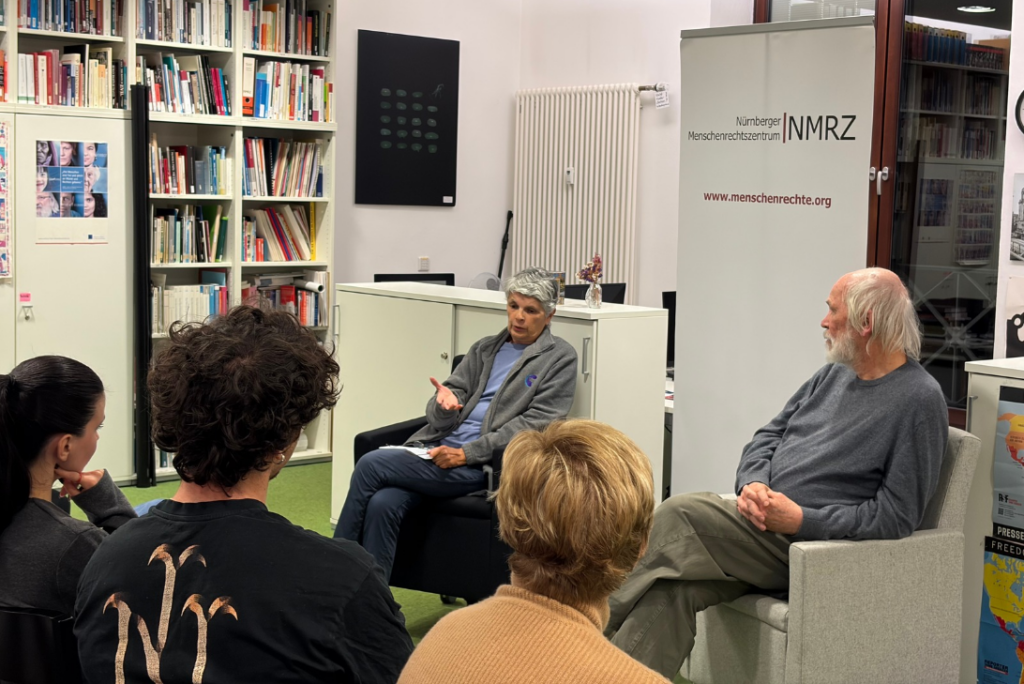
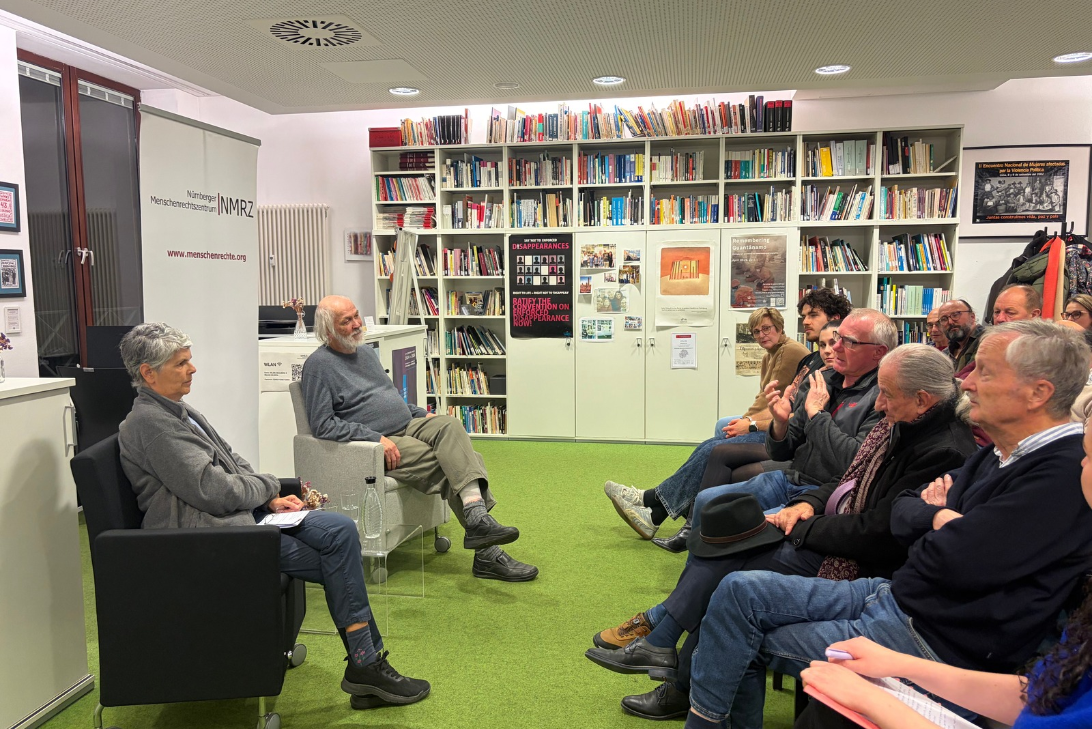
¿Qué pasa en Venezuela? (Was ist los in Venezuela?) was the title of an event held on 9 November 2026 at the Nürnberger Menschenrechtszentrum (NMRZ), where human rights activist Prof. Ligia Bolívar spoke about the current situation in her home country of Venezuela.
What is the state of human rights in Venezuela? What challenges shape the work of human rights organisations, and what opportunities for action does civil society have? These were the questions explored during an evening discussion at the NMRZ on 9 November 2026. Prof. Ligia Bolívar, recipient of the FAU Rudolf Benario Human Rights Award, offered participants insights into the country’s political situation and shared her extensive experience in human rights work. The discussion was moderated by Dr. Rainer Huhle, founding member of the NMRZ and member of FAU CHREN.
From Human Rights Work in Venezuela to Exile
At the beginning of the event, Professor Bolívar spoke about her personal journey and her experience in human rights work in Venezuela. She discussed the work of her human rights organisations, PROVEA and AlertaVenezuela, under six different governments. She also reflected on how the conditions for human rights work evolved during acute crises as well as in seemingly calmer political periods.
She spent eight years in exile in Colombia. From this perspective, she highlighted the gap between Venezuela’s formal commitment to human rights and their implementation in practice. Although human rights played an important role in the country’s legislation, their realisation often failed because of the prevailing political and social conditions.
Political Developments and International Intervention
Prof. Bolívar then turned to recent political developments in Venezuela. Among other things, she discussed the US attack on Venezuela and the subsequent abduction of then-President Nicolás Maduro on 3 January 2026. She strongly criticised the intervention, describing it as a violation of international law.
The discussion also addressed the distribution of power within the Venezuelan government. Prof. Bolívar pointed to the roles of de facto President Delcy Rodríguez and her brother, Jorge Rodríguez, as examples of an increasing concentration of political decision-making power. She described the resulting government structures as a form of family rule.
Human Rights Violations and Restrictions on Press Freedom
Drawing on headlines from the international press, Prof. Bolívar examined various aspects of the human rights situation. One key focus was the situation of political prisoners. Although some detainees had been released, the speaker argued that their release did not amount to a full restoration of their freedom. Many continued to face significant restrictions on their rights, as well as ongoing legal and financial burdens.
Prof. Bolívar also reported on arbitrary arrests and torture, noting that there had been no comprehensive investigation or accountability for these human rights violations. Although the United Nations had been invited to investigate the incidents, the Venezuelan government had, according to her account, failed to cooperate adequately.
She also criticised a programme announced by Amnesty International, which had initially been welcomed with considerable expectations but was discontinued after just two months. In her view, the programme lacked the necessary institutional structures and designated points of contact to ensure effective implementation.
Another key issue was press freedom. At one point, around 200 media outlets had been blocked. Although approximately 70 had since been allowed to resume their operations, restrictions continued to impede free and comprehensive reporting.
The Role of Civil Society and International Responsibility
In addition to political developments and human rights violations, Prof. Bolívar discussed the opportunities available to civil society. Despite the difficult conditions, Venezuela continued to have an active civil society committed to defending democratic rights and human rights. However, these groups needed support from abroad to continue their work.
The discussion also addressed the role of the United States, international intervention and the oil agreement, under which approximately one fifth of Venezuelan oil was expected to go to the United States. Prof. Bolívar painted a sobering overall picture: in her assessment, the human rights situation had deteriorated further. US involvement had added another layer of complexity to an already challenging political and human rights crisis.
About the Speaker: Prof. Ligia Bolívar
Prof. Ligia Bolívar is an internationally recognised human rights activist and recipient of the FAU Rudolf Benario Human Rights Award. For many years, she worked in Venezuela to document human rights violations and promote the protection of human rights, founding and leading her own human rights organisations. After leaving Venezuela, she lived and worked in exile in Colombia. In her presentation, she combined personal experiences from her work in human rights with a critical analysis of political developments in Venezuela. She is currently a Research Fellow at the Cluster of Excellence “Transforming Human Rights”.